
Commercial & industrial lighting · Milton
Commercial Lighting Repair in Milton
One dark fixture, a flickering row and a parking area that will not switch on are different service concerns. Describe what is happening, where it happens and how the affected area is used. Clear observations help frame the service request without asking your staff to investigate electrical equipment.
Request lighting service for an existing commercial or industrial lighting problem in Milton. Include the affected fixtures or zones, when the symptom appears and any access restrictions. A repair discussion can also distinguish an isolated fault from a recurring condition that warrants a separate maintenance or replacement plan.
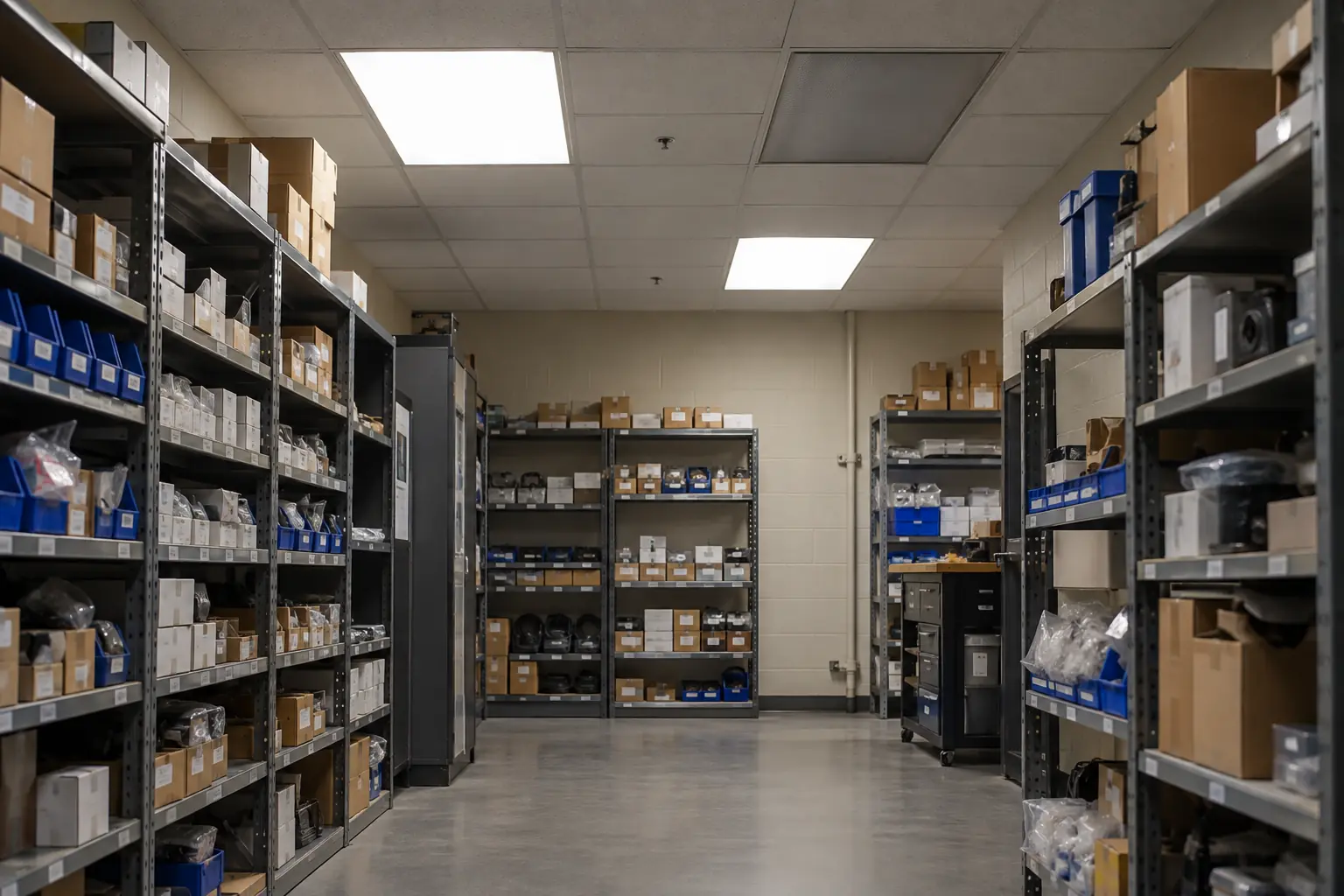
Describe the symptom before naming a failed part
A fixture that appears off does not establish which component has failed. A lamp, driver, ballast, control, connection or supply condition may require consideration during a qualified review. The same visible symptom can arise from different circumstances, and a single photograph cannot settle the diagnosis.
Begin with an observable description: completely dark, intermittently off, visibly flickering, lower output than adjacent fittings, inconsistent colour or switching at the wrong time. Identify the location using a room name, aisle, dock door or pole reference already familiar to the facility. If several fixtures are affected, say whether they form a row, share an area or appear scattered through the building.
Timing matters. Note when the problem was first noticed, whether it occurs throughout the shift and whether the behaviour changes with daylight or normal control schedules. Information from staff who use the area can help clarify the pattern. Report those observations as observations, rather than conclusions about a specific electrical cause.
Do not open fittings, remove covers, climb to read labels or repeatedly operate electrical equipment to reproduce a fault for the enquiry. Use records and accessible ground-level views. If the condition presents an immediate hazard, follow the facility’s safety procedures and involve the appropriate emergency or safety personnel instead of relying on a website enquiry.
For a broader work overview, explore commercial lighting services.
A useful service description
Approximate descriptions are acceptable at the first contact. If a fixture model or pole number is already in a maintenance record, include it. Safe information about the affected area is more valuable than an unsafe attempt to identify a part at height.
| What is visible | Information to share | What should remain unassumed |
|---|---|---|
| One fixture is dark | Its room or aisle location, nearby operating fixtures and when it was last seen working. | The failed component and the suitability of replacement parts. |
| A group is not operating | The extent of the affected zone and any known shared switching or schedule. | That every fitting in the group needs replacement. |
| Light is intermittent or flickering | The timing, affected fixtures and whether staff observe the effect directly. | A diagnosis based only on a phone video or a guessed driver fault. |
| Exterior lights run at the wrong time | The normal expected operation, daylight conditions and whether the whole area behaves alike. | A photocell failure rather than another control or installation issue. |
Isolated failures and wider outages need different scopes
For an isolated failure, identify the individual fitting and its surroundings. A spare-parts room with one dark light may still have a clear service location, while one failed high-bay over a work position can create a more significant operating concern. Describe the activity below the fixture and how the area is currently being managed.
A wider outage needs a broader description. Explain whether an entire office zone, a row of warehouse lights or several exterior fittings are affected. Mention known control groupings from existing records, without attempting electrical testing. That context helps prevent a group behaviour from being mistaken for numerous unrelated fixture failures.
If the problem is recurring, gather the history available. Record dates of earlier service, parts identified on previous invoices and whether the same position or different fixtures were affected. A sequence of repairs can reveal a decision that needs revisiting: component availability, the condition of retained equipment, control compatibility or a lighting arrangement that is difficult to maintain.
Keep the current repair request focused on restoring the affected function. Broader replacement can be considered separately when the evidence supports it. The facility should be able to understand which work responds to the immediate fault and which work is an optional improvement, with distinct assumptions and boundaries for each.
At warehouses, office properties and managed portfolios, connect each symptom to the actual area and the person responsible for it.
Exterior faults: location, operating pattern and access
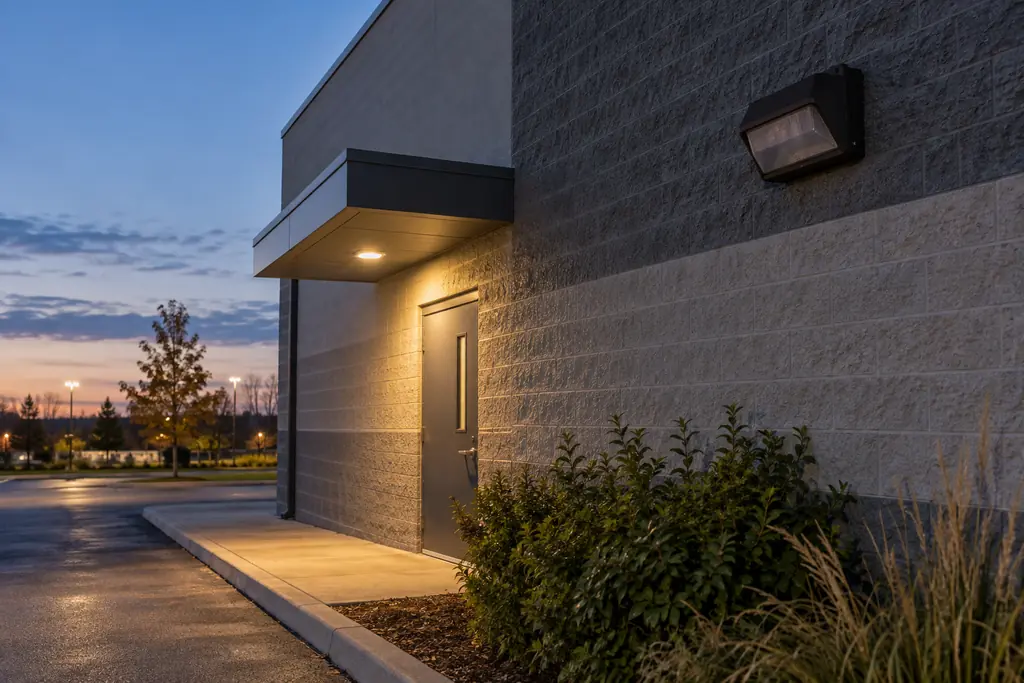
An exterior request should identify the building face, entrance, parking row or service lane involved. Explain whether a fixture is always dark, fails only after part of the evening, remains on during daylight or behaves differently from neighbouring fittings. Note the usual switching arrangement if it is documented, and whether the affected area contains wall packs, canopy lighting or pole-mounted fixtures.
Photographs taken safely from an accessible ground position can show the mounting location and approach. Include a daytime overview where possible, because a dark evening image may hide the access route, nearby structures or the fixture position. Do not use an access ladder or open an outdoor housing to gather information.
Exterior service can depend on traffic, deliveries, parked vehicles and weather exposure. Identify who can authorize access, clear the work area and coordinate any affected pedestrian or vehicle route. A shared commercial property may require the landlord or property manager rather than the occupier of the nearest unit to approve the work.
For an isolated fitting, review wall pack lighting. Where the concern is the switching pattern, photocells and exterior controls provides a more focused pathway. If several poles are involved, the parking lot lighting page explains the information useful for repair and replacement decisions.
For a parking-specific outage, use the parking lot symptom checklist; the repair-versus-replacement guide addresses the separate investment decision.
Control behaviour can look like fixture failure
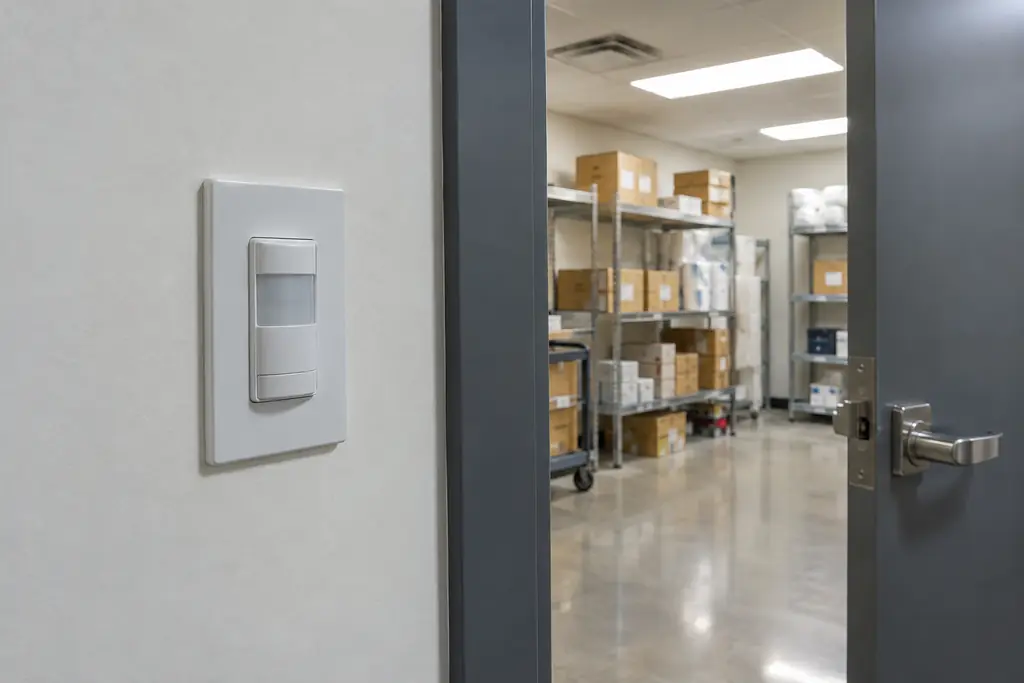
An occupancy-controlled area may remain dark when people expect it to turn on, switch off while a stationary task continues or operate beyond the occupied zone. A photocell or schedule-related issue may appear only at certain times. Describe the intended behaviour and the actual behaviour together; either one on its own can be misleading.
Include recent operational changes. New racks can change the view across a room, altered shift times can conflict with an older schedule, and a recently installed replacement fitting may behave differently under the existing control. These are useful context points for review, not proof that any particular device is defective.
Do not alter programming, bypass controls or open devices to test a theory for the service request. If authorized facility personnel already hold settings or maintenance records, share those records. Preserve the distinction between an observed fault and a proposed operational change, so a service visit does not quietly turn into an undocumented controls redesign.
A control repair may involve confirming the intended sequence as well as the condition of a device. The commercial lighting controls page discusses zones, schedules and overrides for a planned project. Where the immediate need is unreliable operation, the service enquiry should state that concern plainly and identify the area affected.
If the concern is poor coverage rather than failed operation, describe it through dark warehouse aisles or office lighting problems so the service brief identifies that distinction.
Wrong-time outdoor operation can be described using the exterior control checklist.
Flicker and inconsistent output deserve careful descriptions
Flicker may be reported as rapid flutter, occasional dimming or an intermittent change that affects only some fixtures. Staff may see it directly, while a phone camera may show a pattern that is not apparent to the person standing in the area. Note that distinction. A video can be supplementary information, but it should not be used as a diagnosis.
CCOHS explains that flicker can relate to equipment design, condition and supply variation. It also highlights concerns around perception of moving equipment. If flicker affects a machinery area, raise the operating concern with the facility’s safety process and describe the normal work in that location. Do not attempt to reproduce the effect near active equipment for a recording.
Dim output and mixed colour need their own descriptions. A visibly weaker fitting beside others of the same apparent type may warrant a service review, but the apparent difference can also be influenced by lens condition, source type and replacement history. Record whether the change is recent and whether the neighbouring equipment is actually the same model.
For detailed symptom preparation, see commercial lights flickering and commercial lights not working. An enquiry can start with a plain description even when the underlying cause is not known. Avoid buying parts solely on the basis of the symptom.
Plan access without adding risk to the enquiry
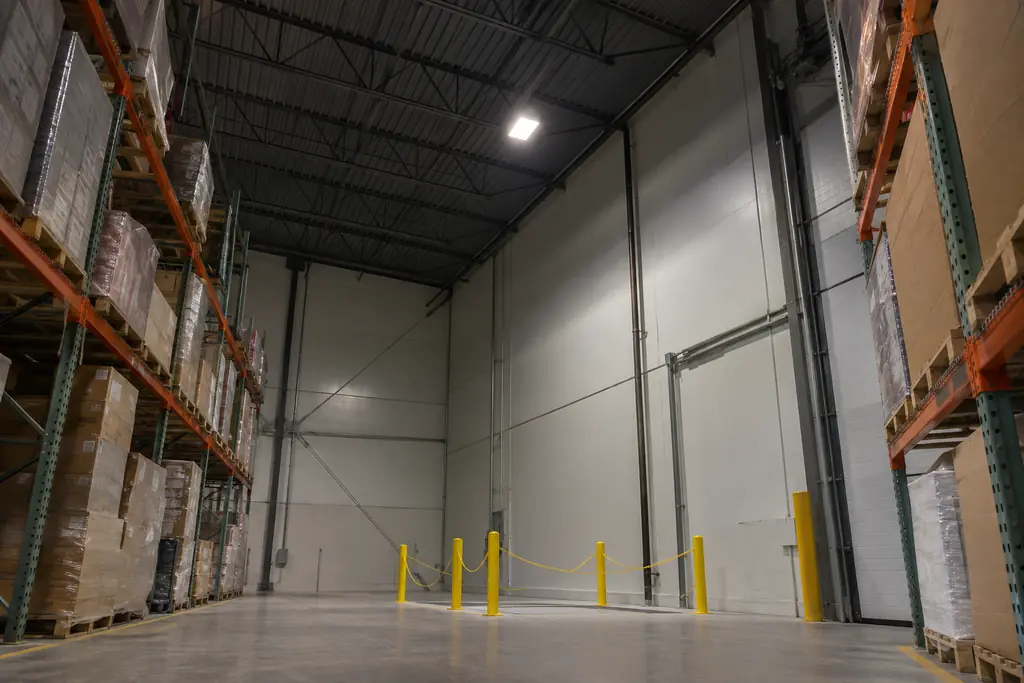
High fixtures and fixtures over busy routes can require more service preparation than their quantity suggests. Record approximate mounting height if known, the aisle width, nearby racks and any equipment that prevents direct access. Mention floors, mezzanines or building rules that may limit the access arrangement. The appropriate method needs to be established for the actual site.
Explain when the affected area can be released. A warehouse cross aisle may be available only between receiving periods, while an office ceiling may be accessible after occupants leave. Include the person responsible for coordinating that window and any approval required before work can start. Do not promise an open area unless the facility can actually provide it.
Work-area preparation may involve moving stock, restricting a route or coordinating with tenants. Agree those responsibilities rather than leaving them until the service date. A clearly defined access window helps a repair scope remain realistic and gives operations staff a basis for planning temporary arrangements.
Where the lighting is high-bay equipment, high-bay LED lighting explains why mounting and distribution matter alongside serviceability. Where recurrent access visits are the main concern, commercial lighting maintenance can help organize a longer-term plan after the immediate fault has been reviewed.
Decide whether to repair, replace or plan a separate upgrade
Repairability depends on the actual fixture, its condition and the availability of compatible support. A serviceable fitting with an isolated component fault may be different from an obsolete housing with recurring problems or damage. The decision should explain what is being retained and why, rather than presenting repair as universally better or replacement as inevitable.
For replacement, compare the affected area with the surrounding system. One new fitting should not introduce an unsuitable distribution, incompatible control response or an unnecessary colour mismatch. If a compatible replacement cannot be established, describe the alternatives and any wider area that would need to be considered.
A broader upgrade may be worth a separate discussion when failures are repeated, access is costly or the lighting no longer suits the use of the building. Keep that proposal distinct from the immediate repair. The LED retrofit pathway can then use an inventory and operating baseline rather than a series of isolated faults as its only justification.
For electrical work, review ESA’s property-owner guidance and confirm the requirements relevant to the scope. Verify the electrical contractor’s licence status through ESA. This process should be established alongside the service authorization, particularly where a tenant, owner and property manager have separate responsibilities.
The property-manager maintenance guide can support a longer-term record after the immediate issue is reviewed. For the current fixture decision, see high-bay lighting or wall packs as appropriate.
Questions about this lighting scope
Can I request service without knowing the fixture model?
Yes. Begin with the facility location, affected area, visible symptom and access conditions. A model recorded on an earlier invoice or schedule is useful, but do not climb or open a fixture to obtain it. Safe overview photographs and a clear location reference can support the initial discussion while identification remains to be confirmed.
Does one dark fixture mean the whole system should be replaced?
No conclusion follows from that symptom alone. Consider the fitting’s actual condition, repair options, surrounding equipment and service history. The immediate fault can be reviewed as a repair scope. If recurring failures or wider performance issues suggest a separate replacement project, those reasons should be explained independently.
What should I say about an intermittent problem?
Record when staff notice it, how long it appears to last and which area is affected. Mention known schedule or operating changes and whether nearby fixtures behave the same way. Do not try to force the fault to occur through electrical intervention. An accurate account of normal observations is the useful starting point.
What if an affected area cannot be used normally?
Explain the operational impact and the arrangements already made under the facility’s safety procedures. Identify any restricted route or task and the site contact responsible for it. A website enquiry is not an emergency response channel. Immediate hazards should be handled through the appropriate safety or emergency process while service requirements are organized.
Lighting service
Request service for the lighting that is not working.
Share the affected area, what you have noticed and the access restrictions. Include ground-level photographs if they can be taken safely.